Taxes
NRA Tax Residency Check: Foreign Accounts and Crypto Exchanges

Contents
A letter from the National Revenue Agency (NRA, the Bulgarian tax authority) with dozens of questions about where you live, which accounts you hold abroad and where your money comes from is usually unsettling. In reality it is a standard procedure that has been triggered for more and more people in recent years, because the NRA receives more and more data from abroad and matches it against the tax returns people file.
Below we take apart a real request from October 2026 (personal data removed): your rights under the law, the difference between a tax inspection and a tax audit, how NRA acts are appealed, and what the tax administration actually “sees” about your accounts at Revolut, Wise, your broker and centralised crypto exchanges under the legislation in force as of October 2026.
1. What exactly the NRA asks for: the letter, point by point
The document is a Request for documents and written explanations from an obligated person (Bulgarian abbreviation ИПДПОЗЛ), form Kd40, version 3. It is issued under Article 37(2) and (3) of the Tax and Social Security Procedure Code (TSSPC) and contains the warning under Article 56 TSSPC: if you do not give written explanations on time, the authority may treat the relevant facts as proven or unproven, and you may be summoned before a court under Article 176 of the Civil Procedure Code.
The key points visible from the letter itself:
- This is an inspection, not a tax audit. The request is issued “in connection with an inspection” no. P-…-0RP-001/06.10.2026. A tax audit can only be opened by an audit assignment order (Article 112 TSSPC), and there is none here. In practice “0RP” in the number marks the inspection, while “040” corresponds to the Kd40 request form.
- Period under review: 1 January 2024 to 31 December 2025 inclusive.
- Purpose: the NRA wants to establish whether, for 2024 and 2025, the person was a Bulgarian tax resident (Article 4 of the Personal Income Taxes Act, PITA) and whether they have undeclared income from Bulgaria or abroad (points 8–12 of the request).
- Why is the letter on the Sofia directorate’s letterhead while the inspector sits in Varna directorate, Targovishte office? This is not a mistake. Under the general rule, the competent territorial directorate is the one for the person’s permanent address (Article 8(1)(1) TSSPC), here Sofia. However, when the inspection is assigned by the NRA executive director or a person authorised by them, the territorial competence rules of Article 8 do not apply (Article 110(4), second sentence, TSSPC). In practice the NRA distributes cases among offices across the country. The reply goes to the inspector named in the letter, most conveniently through the NRA online portal.
- Deadline: 14 days from proper service (signing the receipt on page 5 or electronic service through the NRA portal). The period runs from the day after service and ends at the end of the last day (Article 22(6) TSSPC). If the last day is a non-working day, it ends on the next working day (Article 22(7)). If you file in person at the office, the deadline ends when the office closes; electronically, at midnight (Article 22(8)). The authority cannot set a period shorter than 7 days (Article 22(1)).
- Requirements for electronic files. The letter refers to the amendment of the Administrative Procedure Code (APC, State Gazette No. 63 of 2025, in force from 1 July 2026), under which the administrative file is sent to the court electronically. So when you file electronically, every document must be in a separate file, scanned in full, with a clear name (e.g. “Statement_Revolut_2024.pdf”, “Explanation_income.pdf”), signed with an electronic signature and ordered as listed in your cover letter. The request itself warns that documents not meeting these requirements may be disregarded by the court in any later case.
- Two more obligations from the letter that are often missed: name all third parties and institutions holding documents relevant to the inspection (Article 37(2) TSSPC), and if you have already submitted the same documents to the NRA in another proceeding, give that proceeding’s reference number.
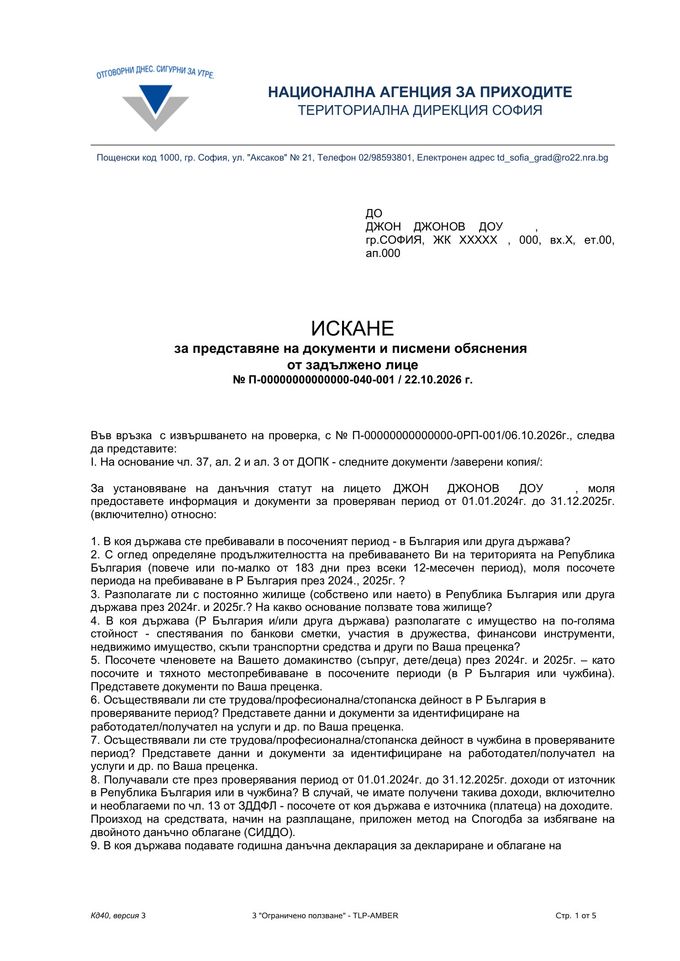
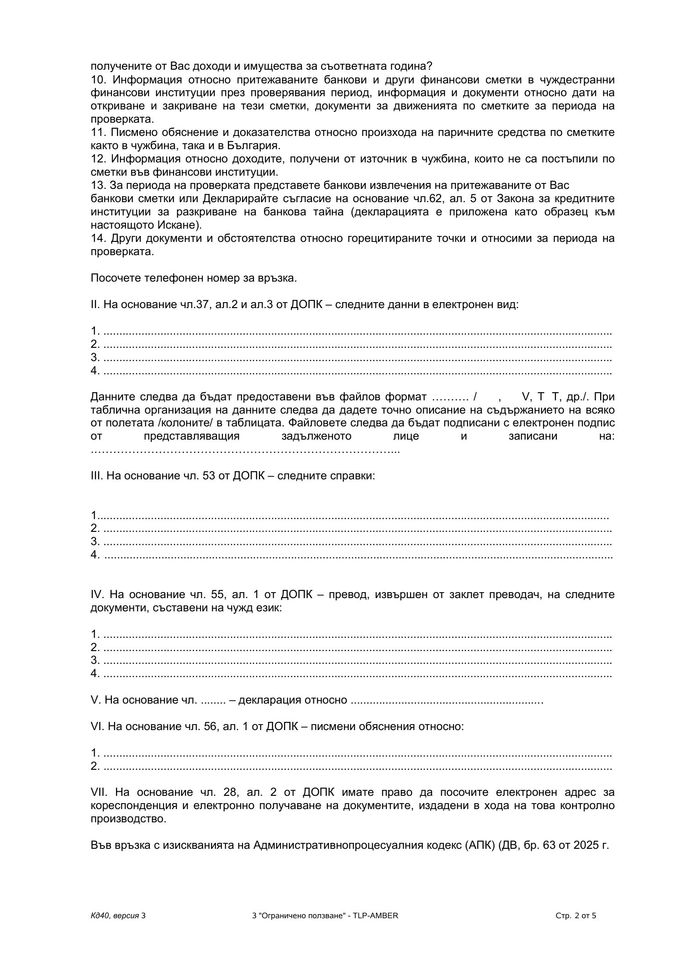
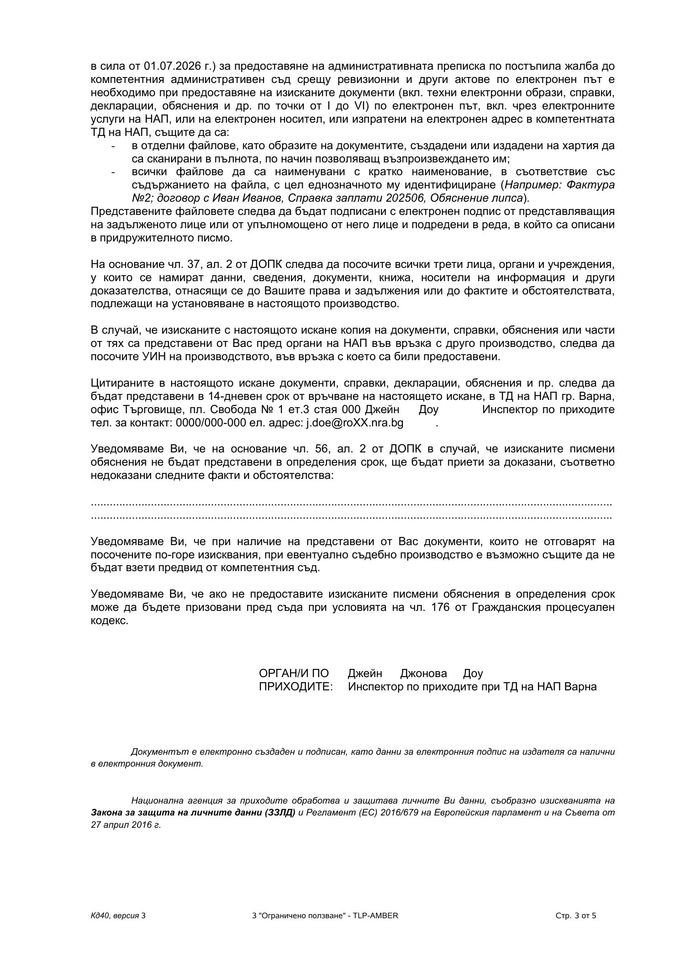
The full request with personal data removed (PDF in Bulgarian, 5 pages) (opens in a new tab)
2. Inspection or tax audit: the difference
Tax control is carried out through tax audits and inspections (Article 110(1) TSSPC). In plain terms: the inspection is the preliminary inquiry, and the audit is the proceeding in which taxes are assessed.
| Feature | Inspection | Tax audit |
|---|---|---|
| Main purpose | Establishing facts and circumstances, e.g. whether the person is resident and where the money in the accounts comes from (Article 110(3) TSSPC). | Establishing liabilities for taxes and compulsory social security contributions (Article 110(2) TSSPC). |
| Can it assess tax? | No. An inspection does not establish tax or contribution liabilities (Article 110(3), third sentence, TSSPC). | Yes. It ends with an act under which you owe real amounts (principal and interest), enforceable against you. |
| How does it start? | No express written assignment is required (Article 110(4) TSSPC). In practice an internal resolution that is not served on you; you usually learn of the inspection from the first request. | With an audit assignment order under Article 112 TSSPC, which is served on you. |
| Time limit | Up to 6 months from the first procedural step (e.g. a served request under Article 37(3)), extendable by up to 6 more months, unless a law provides otherwise (Article 110(5) TSSPC). | Up to 3 months from service of the order, extendable by up to 2 months (Article 114(1)–(2) TSSPC). In cases of particular factual complexity, up to 3 years in total (Article 114(4)). |
| How does it end? | With a record (protocol) (Article 110(4) and Article 50 TSSPC), given to you within 7 days (Article 110(5)). | With an audit report (Article 117 TSSPC) and then an audit act (Articles 118–120 TSSPC). |
📌 How are the two connected?
If you give convincing explanations and documents during the inspection, the case closes with a record and no consequences. If the inspection points to undeclared income (or you do not reply), the usual next step is a tax audit, in which taxes are actually assessed.
3. Can the inspection record be appealed?
Short answer: no. The inspection record cannot be appealed on its own, either before the NRA or in court.
- Why? Under Article 110(3) and (4) TSSPC and the settled case law of the Supreme Administrative Court (SAC), the inspection record certifies what the authority checked and found, but it is not an individual administrative act (Article 21 APC). It does not impose any obligation to pay tax. An appeal against such a record will be left without examination as inadmissible (Article 159(1) APC, applicable through § 2 of the Supplementary Provisions of the TSSPC).
-
So how do you respond to wrong conclusions in the record?
- Written objection. The record must reflect any requests, notes and objections made (Article 50(2)(10) TSSPC). You can also file a written statement with additional evidence after receiving it. Sometimes this is enough to avoid an audit.
- Defence in a later audit. The record is evidence of the facts it establishes (Article 50(1) TSSPC), but its legal conclusions bind neither the auditors nor the court. If an audit is opened on its basis, every statement in it can be rebutted there.
4. Defending yourself in a tax audit: report, act, court
Once the NRA opens an audit, your defence runs through three clearly separate stages:
| Stage | Deadline | Before whom | Legal basis |
|---|---|---|---|
| Objection to the audit report | 14 days from service; on request, extended by up to 1 month | The auditors | Art. 117(5) TSSPC |
| Appeal against the audit act (mandatory) | 14 days from service | Director of the Appeals and Tax and Social Security Practice Directorate at NRA headquarters, filed through the territorial directorate | Art. 152 and Art. 156(2) TSSPC |
| Decision on the appeal | 60 days; by mutual agreement, extended by up to 3 months | – | Art. 155(1) and Art. 156(7) TSSPC |
| Appeal to the administrative court | 14 days from the decision; 30 days if no decision is made | Administrative court for your permanent address, filed through the Appeals Directorate | Art. 156(1), (4) and (5) TSSPC |
| Cassation appeal | 14 days from notice of the judgment | SAC, through the administrative court | Art. 160(7) TSSPC; Art. 211 APC |
Stage 1: Objection to the audit report (Article 117(5) TSSPC)
- When the audit ends, the auditors draw up an audit report. It is not yet an order to pay, but a reasoned proposal of the taxes and interest they intend to assess.
- Within 14 days of service you may file a written objection and new evidence with the auditors.
- Useful tip from the law: if 14 days are not enough (for example, you are waiting for documents from a foreign bank or tax authority), ask for an extension before the period expires; on the person’s request it is extended by no more than one month (Article 117(5), second sentence, TSSPC).
Stage 2: Mandatory administrative appeal against the audit act (Articles 152–155 TSSPC)
- After considering your objection, the auditors issue an audit act (Articles 118–120 TSSPC), which formally establishes the liabilities.
- Key rule: the audit act cannot be challenged in court to the extent it was not first appealed administratively (Article 156(2) TSSPC). You must first appeal to the director of the Appeals and Tax and Social Security Practice Directorate at NRA headquarters.
- Deadline and filing: 14 days from service of the act, through the territorial directorate that issued it (Article 152(1)–(3) TSSPC).
- Decision: the director has 60 days (Article 155(1)), counted after the territorial directorate forwards the file (it has 7 days for that under Article 146). The director may confirm, amend or revoke the act in whole or in part. The director may also revoke it and send the file back for a new act, where the evidence is incomplete and cannot be gathered in the appeal, or where there were material procedural breaches, but only once (Article 155(4)–(5)). The decision cannot make your position worse (Article 155(8)).
- Careful: the appeal does not stop collection automatically. An administrative appeal does not suspend enforcement of the act (Article 153(1) TSSPC). To keep your accounts from being garnished during the appeal, file a request to suspend enforcement with security covering principal and interest (Article 153(2)–(3)). If the security is cash, an unconditional and irrevocable bank guarantee or government securities, suspension is mandatory (paragraph 4); with other assets (e.g. a mortgage) it is at the authority’s discretion (paragraph 5). The decision is due within 7 days, and a refusal can be challenged in court within 7 days (paragraphs 6 and 7).
Stage 3: Court appeal (Articles 156–161 TSSPC)
- If the director confirms the act, you have 14 days from receiving the decision to appeal, through the director, to the administrative court for your permanent address at the time of the first control step (Article 156(1) TSSPC). If the director does not decide on time, the act is deemed confirmed (“tacit confirmation”) and you have 30 days from the end of the decision period (Article 156(4)–(5)).
- Courts often appoint an independent forensic accounting expert to check the calculations and the bank transfers.
- The administrative court’s judgment can be appealed within 14 days to the final instance, the Supreme Administrative Court (Article 160(7) TSSPC and Article 211 APC).
5. On what grounds an audit act falls
The court reviews the lawfulness and the factual basis of the act: whether it was issued by a competent authority and in the proper form, and whether procedural and substantive rules were observed (Article 160(2) TSSPC). The grounds for annulment are the five grounds in Article 146 APC:
- Lack of competence (nullity). The act was issued by officials without legal authority, e.g. the audit was assigned by someone without that power under Article 112 TSSPC, there is no valid assignment order, or the electronic signatures are invalid.
- Breach of form and lack of reasons (Article 120 TSSPC). The act does not explain where the figures come from, does not address your objections and evidence, or lacks mandatory elements.
- Material procedural breaches. Evidence was gathered outside the audit period, your right of defence was breached, or the so-called “assessment by analogy” (Article 122 TSSPC) was applied unlawfully, without proving grounds for it.
-
Wrong application of the law and lack of factual basis. This is the most common ground. Examples from practice:
- the NRA treated you as a Bulgarian resident although you actually live and work abroad;
- the NRA taxed at 10% amounts in your bank account that are not income: transfers between your own accounts (from a Bulgarian bank to Revolut), repaid loans, loans received, gifts and help from relatives (what is received as a gift is not income, Article 13(2) PITA) or savings from earlier years;
- the NRA ignored the acquisition cost of financial assets or crypto-assets and taxed the entire transfer instead of the actual gain (Article 33(3)–(4) PITA);
- liabilities were assessed for years for which the assessment period or the limitation period had expired (Articles 109 and 171 TSSPC).
- Inconsistency with the purpose of the law. The authority used its powers improperly, contrary to the principles of objectivity and good faith (Articles 3 and 6 TSSPC).
6. Why the NRA sends such letters
Points 1–9 of the letter are the NRA’s standard questionnaire for determining tax residency under Article 4 PITA; points 10–14 concern accounts and the origin of funds. Such letters are usually not random: they go out when the NRA’s data show an inconsistency. The most common triggers in practice:
- Data from a foreign bank, fintech platform or broker (Revolut, Wise, Paysera, N26, Interactive Brokers, eToro). Every year by 30 September the NRA receives data from abroad on accounts of persons with indications of Bulgarian residence (automatic exchange under CRS). If those accounts show significant balances, interest, dividends or securities sales for 2024–2025, but the person has not filed an annual tax return under Article 50 PITA, the mismatch is obvious.
- More than 25 cross-border payments to you in a quarter (CESOP). Since 1 January 2024 payment service providers keep a register of payees receiving more than 25 cross-border payments a quarter and file it with the tax administration (Article 123a of the VAT Act). The data go into the EU CESOP system, which the NRA can access. The system was built for VAT control, but a signal from it easily leads to questions about income too.
- Expensive purchases without matching declared income. You bought property or an expensive car in Bulgaria in 2024–2025, but the NRA has no declared income on record to explain it. A mismatch between wealth and declared income is also a separate ground for assessment under the special procedure (Article 122(1)(7) TSSPC).
- Income from online platforms (DAC7) and cash-on-delivery payments. Platforms such as Airbnb, Booking, Etsy, eBay, Upwork and Fiverr have reported sellers and service providers since 2023. The NRA also analyses data from courier companies on cash-on-delivery payments.
- You live abroad but left “loose ends” in Bulgaria. You opened the foreign bank or platform account with a Bulgarian ID card, Bulgarian personal number and permanent address in Bulgaria. So the foreign country reports you to the NRA as a Bulgarian taxpayer.
7. Are you a tax resident? How to reply
If you are a Bulgarian resident, you owe tax here on your worldwide income (Article 6 PITA). If you are a non-resident, you owe Bulgarian tax only on Bulgarian-source income, e.g. rent from a flat in Sofia (Article 7 PITA).
Under Article 4(1) PITA, a resident individual, regardless of citizenship, is a person who:
- has a permanent address in Bulgaria, or
- stays in Bulgaria for more than 183 days in any 12-month period (the days of exit and entry each count; stays solely for study or medical treatment do not count, Article 4(2)–(3)), or
- has been posted abroad by the Bulgarian state, its bodies or Bulgarian enterprises (together with family members), or
- has their centre of vital interests (family, property, work, business) in Bulgaria.
💡 The key exception (Article 4(5) PITA)
Almost every Bulgarian citizen has a permanent address in Bulgaria. The law, however, says expressly that a person with a permanent address in Bulgaria whose centre of vital interests is not in the country is not a resident. The exception only “rescues” you from the permanent-address test: if you stayed in Bulgaria for more than 183 days in a 12-month period, you are resident regardless. In addition, if Bulgaria has a double tax treaty with the country where you live, the treaty prevails over PITA (Article 75 PITA). We cover the tie-breaker rules for dual residents in detail in “Tax Resident of Half of Europe (and of One Ship)”.
Scenario A: in 2024 and 2025 you actually lived and worked abroad
- What to reply: under points 1–9, state clearly that in 2024 and 2025 you spent fewer than 183 days a year in Bulgaria, that your centre of vital interests (work, home, family, social and health insurance) was in the foreign country, and that under Article 4(5) PITA (and the applicable tax treaty) you are not a Bulgarian tax resident, so you do not have to declare or pay tax here on your foreign income.
- Who has to prove it: where the facts lie outside Bulgaria, the burden of proving them is yours (Article 116(1) read with Article 110(6) TSSPC). The NRA may ask for documents in a foreign language to be translated by a sworn translator (Article 55(1) TSSPC).
-
Evidence to attach:
- a certificate of tax residence from the foreign tax authority for 2024 and 2025, the strongest document;
- foreign tax returns or proof of tax paid abroad (e.g. P60 / Self Assessment in the UK, Lohnsteuerbescheinigung in Germany);
- a lease or title deed for your home abroad and utility bills;
- your employment contract with the foreign employer;
- plane tickets or other records of your travel.
Scenario B: in 2024 and 2025 you lived in Bulgaria (you are resident)
Confirm that you live in Bulgaria. Then, in your written explanations under points 8, 10 and 11, give a clear and calm breakdown of the money that went through your accounts in 2024 and 2025:
- Opening savings at 1 January 2024. Show how much you had at the start of the period. That money was acquired before 2024 and is not income for 2024–2025.
- Movements that are not income at all: transfers between your own accounts (e.g. from your Bulgarian account to your Revolut and back), topping up an account with your own money, loans received, loans repaid to you, refunds from merchants.
- Amounts that are not taxed: gifts and help from parents, children or a spouse (gifts are not income under Article 13(2) PITA, and no local gift tax is due between direct relatives and spouses under the Local Taxes and Fees Act); trades in financial instruments on an EU/EEA regulated market (Article 13(1)(3) PITA); the sale of one residential property held for more than 3 years and of up to two other properties held for more than 5 years in the year (Article 13(1)(1) PITA); the sale of personal belongings, with the exceptions in Article 13(1)(2) PITA (e.g. vehicles held for less than a year, works of art, financial assets, currency).
- Taxable income: salaries, fees, freelance income, gains from crypto-assets or foreign shares, dividends, interest.
📌 If there is undeclared income
If you have undeclared taxable income for 2024 or 2025, get advice on filing an annual tax return under Article 50 PITA before you reply. A return not filed by the start of an audit is one of the grounds for assessment under the special procedure (Article 122(1)(1) TSSPC). A late return brings interest and the risk of a fine, but it is usually far better than a hard audit.
8. Should you sign the bank secrecy waiver?
In point 13 (page 2) of the letter the inspector asks you to:
submit bank statements for your bank accounts for the inspection period or declare consent under Article 62(5) of the Credit Institutions Act to the disclosure of bank secrecy (a template declaration is attached).
Our recommendation: do not sign the blanket declaration under Article 62(5) of the Credit Institutions Act. Choose the first option instead: download and submit your bank statements for 1 January 2024 – 31 December 2025 yourself.
Why this is the right move:
- The letter gives you a choice. It uses the word “or”. When you submit the statements for the period yourself, you meet your obligation under Article 37 TSSPC and do not need to waive bank secrecy.
- Without your consent the NRA does not see the movements on your Bulgarian accounts. A bank may disclose a client’s bank secrecy only with the client’s consent (Article 62(5)(1) of the Credit Institutions Act) or by court decision. The head of an NRA territorial directorate can request such a decision only in specific cases, e.g. where there is evidence that the person obstructed the inspection or audit or keeps no proper records, or at the request of a public enforcement agent (Article 62(6)(3) of that Act).
- You control the context. When you pull the statements yourself, you can review them and explain every larger incoming payment. If you sign the declaration, the bank sends raw data straight to the inspector with no explanation, and every incoming transfer risks being treated as income.
- The consent does not cover foreign accounts. It concerns Bulgarian banks. For Revolut, Wise and other foreign accounts you download the statements from the app anyway.
⚠️ Do not hide the accounts themselves
Although the NRA does not see the movements on your Bulgarian accounts without statements or consent, it has access to the Bulgarian National Bank’s Register of Bank Accounts and Safe Deposit Boxes (Article 56a of the Credit Institutions Act). It lists every IBAN account at banks, payment institutions and e-money institutions in Bulgaria, with holders and authorised persons. Also, if you do not submit the requested evidence, the authority may assume it does not exist (Article 37(4) TSSPC).
9. How many years back can the NRA look?
Two rules apply here: one for this specific letter and one for the statutory maximum:
- Under this letter: only 2024 and 2025. The scope is stated expressly on page 1: 1 January 2024 to 31 December 2025. Documents for earlier years are relevant only if they prove where the money came from (e.g. savings at 1 January 2024), and then it is in your interest to submit them.
-
Under the law: 5 years after the year of filing. No proceeding to assess taxes may be opened once 5 years have passed from the end of the year in which the return was filed or should have been filed (Article 109(1) TSSPC).
- For 2020 income, the annual return was due by 30 April 2021.
- The five-year period runs from the end of 2021 and expires on 31 December 2026.
- So in 2026 the NRA can assess tax going back to 2020 income at most. For 2019 and earlier the period has expired. The exceptions are criminal proceedings on which the tax assessment depends (Article 109(2)) and a final decision in a dispute under Article 134e or 134r (Article 109(3)).
Separately, liabilities that have already been established become time-barred under Article 171 TSSPC (5 years, with an absolute limit of 10 years).
10. What the NRA knows about Revolut, Wise, brokers and crypto exchanges
Many people still believe that a foreign IBAN (in Lithuania, Belgium or Germany) or a crypto exchange account is invisible to the NRA. As of 2026 that is not true. Here is what information the NRA has by law:
Foreign accounts at Revolut, Wise, Paysera, N26 and others
The NRA receives information about them automatically through two mechanisms.
Mechanism 1: annual automatic exchange of financial account information (CRS / DAC2), Section IIIa of Chapter Sixteen TSSPC (Articles 142a–142sht).
- Revolut serves Bulgarian clients through a bank licensed in Lithuania (Revolut Bank UAB), and Wise through an institution licensed in Belgium (Wise Europe SA).
- Financial institutions report to their own tax authority by 30 June, which sends the data to the account holder’s country of residence by 30 September of the following year. This is how the NRA receives data from all EU countries and many other jurisdictions on accounts of persons with a Bulgarian tax number or address.
- What the NRA sees in the CRS report: name, Bulgarian personal number, address, account number, the balance at 31 December (or at closure), total interest, dividends and gross proceeds from sales of financial assets (e.g. Flexible Cash Funds, or shares and ETFs in the app).
- What it does not see: the full history of transfers during the year. That is why, in points 10 and 13 of the letter, the inspector asks for statements: the NRA already knows you have a Revolut/Wise account and how much was in it on 31 December 2024 and 31 December 2025, but wants to check where the money came from.
Mechanism 2: quarterly reporting of cross-border payments (CESOP), Article 123a of the VAT Act, in force since 1 January 2024.
- If your Revolut, Wise, PayPal or other payment account receives more than 25 cross-border payments in a calendar quarter, the provider reports you to the EU CESOP system.
- Each individual payment is reported: date, amount, currency and the country the payment came from. The payer’s name is not reported; the report is about the payee.
Investment brokers (Interactive Brokers, eToro, Saxo Bank and others)
The NRA has information every year. These platforms are custodial institutions (§ 1a(4) of the Supplementary Provisions of the TSSPC) and report under CRS your account, the value of your portfolio at 31 December, dividends received and gross proceeds from sales of shares, bonds and ETFs for 2024 and 2025. This applies to brokers established outside Bulgaria; Bulgarian intermediaries do not report their local clients under CRS.
Centralised crypto exchanges (Kraken, Coinbase, Crypto.com, Bybit and others)
Here the law distinguishes between the period before and after 1 January 2026.
For the period covered by the letter (2024 and 2025) crypto-assets were not reported automatically. Even so, the NRA can trace accounts and turnover in several ways:
- Through bank transfers and card payments (fiat on/off-ramp). Every top-up of an exchange by card or transfer from a Bulgarian bank, Revolut or Wise, and every withdrawal of euro or dollars back, leaves a clear trail with the exchange’s company name (e.g. Payward for Kraken, Foris DAX for Crypto.com).
- Through crypto cards and IBAN accounts linked to exchanges. These are run by licensed e-money institutions and banks whose CRS and CESOP reports can cover those accounts too.
- Through a request under EU administrative cooperation (Section V of Chapter Sixteen TSSPC). On 1 July 2026 the MiCA transitional period ended, and serving EU clients now requires a licence in a member state (e.g. Kraken – Ireland, Coinbase – Luxembourg, Bybit – Austria, Crypto.com – Malta). On an official request, licensed providers hand over KYC data, balances and trade history.
From 1 January 2026: DAC8 in the TSSPC. By the act amending the TSSPC published in State Gazette No. 85 of 15 September 2026, Bulgaria transposed Directive (EU) 2023/2226 (DAC8) and, through it, the OECD CARF standard, in a new Section IIIb of Chapter Sixteen TSSPC (Articles 142yu–142ya10), in force from 1 January 2026.
- Who reports: crypto-asset service providers licensed under MiCA, and operators from third countries that serve EU clients and must register in one member state. They report in the state of their licence or registration (in Bulgaria, to the NRA by 30 June of the following year), which forwards the data to the user’s state of residence within 9 months after the end of the year (Article 142yu(5) and Article 142ya2(7) TSSPC).
- When: the first data cover 2026 and will reach the NRA by 30 September 2027 at the latest. There are no DAC8 data for 2024–2025.
- Client data: name, address, state of tax residence, tax number (in Bulgaria, the personal number), date of birth (and place of birth only if the provider must collect it under other rules).
- Transaction data, aggregated for the year per type of crypto-asset: total amount paid or received, number of units and number of transactions for purchases and sales against fiat; total fair market value, number of units and number of transactions for crypto-to-crypto exchanges (including stablecoins such as USDT/USDC); payments for goods and services; incoming and outgoing transfers.
- Transfers to external wallets (Ledger, Trezor, MetaMask): total market value and number of units transferred to addresses not known to belong to a service provider.
📌 Important
DAC8 does not report each transaction separately but annual totals per type of crypto-asset. So in an inspection the NRA will still ask for the exchange statements, but it will know what to look for. Exchanging one crypto-asset for another is also a taxable transaction under Article 33(3) PITA.
11. Step-by-step action plan
- Write down the exact date of service and count 14 days. If the last day is a Saturday, Sunday or public holiday, the deadline moves to the next working day (Article 22(7) TSSPC).
- If 14 days are not enough, before the deadline expires ask the inspector for an extension under Article 25 TSSPC (with good reasons; the extension cannot exceed the original period) or for a stay of the proceeding under Article 34(1)(5) TSSPC (once, for no more than 3 months; no answer within 7 days counts as a tacit refusal).
- Collect your bank statements for 2024 and 2025 from Bulgarian banks and from foreign fintech platforms (Revolut, Wise and others, on which the NRA already has CRS data) and submit them yourself, without signing the bank secrecy waiver under Article 62(5) of the Credit Institutions Act.
-
Prepare a clear written explanation following points 1 to 14 exactly:
- if you live abroad, evidence that your centre of vital interests is outside Bulgaria (Article 4(5) PITA) and a certificate of tax residence;
- if you live in Bulgaria, separate the transfers between your own accounts, the non-taxable amounts (savings from before 2024, help from relatives, loans, trades on an EU regulated market) and actual income;
- name third parties holding documents (Article 37(2) TSSPC) and the reference numbers of other proceedings in which you already submitted them.
- File the documents with a list through the NRA e-services with a qualified electronic signature, keeping each document in a separate, clearly named file. Give a phone number and, if you wish, an e-mail address for correspondence (Article 28(2) TSSPC).
This article is for information only and does not replace individual advice. The letter is published as an example; the personal data in it were replaced with fictitious names (John Doe, Jane Doe) and the case numbers with zeros. Conclusions depend on the specific facts; check the current versions of the acts cited before relying on them.
Sources
- Tax and Social Security Procedure Code (last amended State Gazette No. 85 of 15 September 2026): Articles 3, 6, 8, 22, 25, 28, 34, 37, 50, 55, 56, 109, 110, 112, 114, 116, 117, 118–120, 122, 146, 152–156, 160, 171; Articles 142a–142sht (CRS/DAC2); Articles 142yu–142ya10 (DAC8/CARF); § 1a and § 2 of the Supplementary Provisions
- Personal Income Taxes Act: Articles 4, 6, 7, 13, 33, 50, 75
- Credit Institutions Act: Article 56a (Register of Bank Accounts and Safe Deposit Boxes); Article 62(5)–(6) – text on the BNB website (in Bulgarian) (opens in a new tab)
- VAT Act: Article 123a (CESOP)
- Local Taxes and Fees Act: Article 44(6)
- Administrative Procedure Code (amended State Gazette No. 63 of 2025, in force from 1 July 2026): Articles 21, 146, 159, 211
- Directive (EU) 2023/2226 (DAC8); Regulation (EU) 2023/1114 (MiCA)
- Request for documents and written explanations from an obligated person, form Kd40, version 3 (October 2026, personal data removed)
This article is for information only and reflects the law as of its publication date. It is not individual tax or legal advice.

Author
Marina Muchakova
Tax consultant with a law degree and over 15 years of experience in tax law.