VAT
VAT Registration When Trading Shares via Interactive Brokers

Contents
Over recent months we have received a growing number of questions from investors and traders who deal in shares and other financial instruments through Interactive Brokers and other foreign investment firms. The most frequent question is:
“Now that my turnover from selling financial instruments has exceeded the VAT registration threshold, am I obliged to register?”
The answer is not clear-cut.
Reaching a certain volume of sales does not automatically create an obligation to register under Art. 96 of the Bulgarian VAT Act. The specific activity, the manner in which the trades are carried out, the relationship with the investment firm and the place of supply of the relevant supplies all have to be analysed.
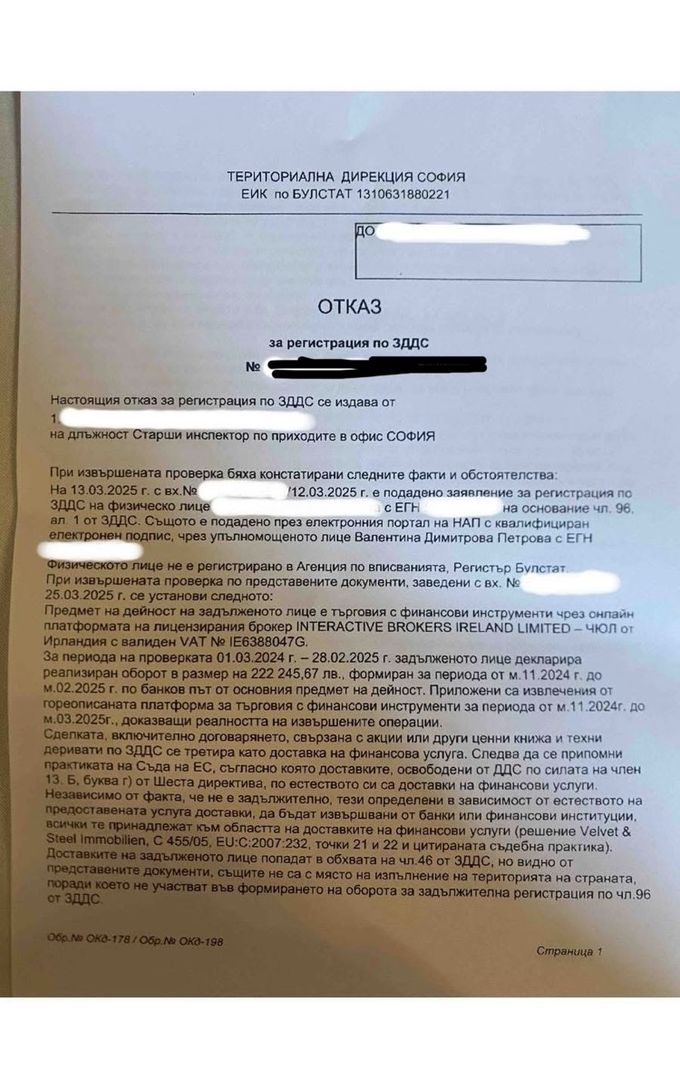
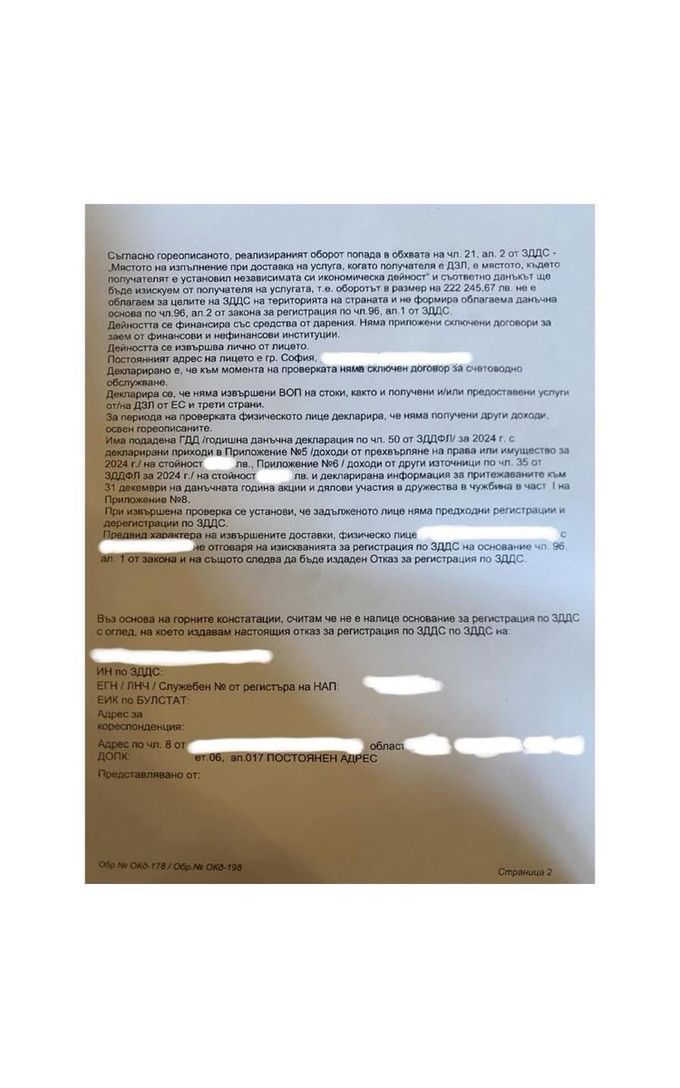
This article examines a concrete case in which, after an application under Art. 96 of the VAT Act was filed and a review carried out, the Bulgarian Revenue Agency (NRA) issued an act refusing registration.
It is important to stress at the outset that every case has its own particularities. The reasoning set out below is not a universal solution and cannot be applied mechanically to every person who invests or trades in financial instruments.
How the procedure starts
After an application for registration under Art. 96 of the VAT Act is filed, the revenue authority normally carries out a review of the declared circumstances. As part of that review the applicant may receive a demand for the submission of documents and written explanations from an obligated person, known as an “ИПДПОЗЛ”.
The demand may request documents and information regarding:
- the nature of the activity carried out;
- the investment firm used;
- the purchases and sales made;
- the amount of turnover received;
- the bank transfers;
- the contractual relationship with the broker;
- the manner and place of execution of the trades;
- the statements from the investment platform;
- the annual tax returns filed;
- other income and business activities of the person.
The response to this demand is especially important, because it is where the factual and legal basis of the applicant’s position is presented.
The key question: where is the place of supply
The sale of shares and other financial instruments may constitute an exempt supply within the meaning of Art. 46 of the VAT Act. That, however, does not mean that every sale automatically counts towards the turnover for mandatory registration under Art. 96 of the VAT Act.
For a given supply to be included when determining turnover, all applicable statutory preconditions must be met. What matters, for example, is:
- whether the person carries out an independent economic activity within the meaning of Art. 3 of the VAT Act;
- whether the relevant supplies are part of that person’s main activity;
- whether the place of supply is on the territory of Bulgaria.
These preconditions must be considered together, not in isolation.
In the case at hand the main line of reasoning concerns the place of execution of the trades and the role of Interactive Brokers Ireland Limited in carrying them out.
How Interactive Brokers works
Interactive Brokers Ireland Limited is an investment firm established in Ireland.
In order to use the platform, every client enters into a client agreement. It governs the rights and obligations of the parties, as well as the manner in which the broker accepts, routes and executes client orders.
Several important circumstances can be derived from the provisions of the client agreement. Interactive Brokers may:
- select the market or dealer to which the client order is routed;
- use an automated smart-routing system;
- execute the order through another broker or an affiliate;
- execute orders as agent and, in certain cases, as principal;
- decline to execute a given order;
- correct or cancel a reported execution where there is an error;
- carry out proprietary trading, including while holding unexecuted client orders for the same financial instruments.
This means that the client does not, in every case, determine the specific market, the counterparty and the technical manner in which the order will be executed.
Even where a financial instrument is listed on a particular exchange, the actual execution may be reported on another market, through a different trading segment, or by means of another permissible execution mechanism.
After the operation is completed, Interactive Brokers records the result in the client account and in the relevant reports.
Download the Interactive Brokers Client Agreement (PDF, 30 pages) (opens in a new tab)
Direct and indirect representation
Bulgarian civil and commercial law usually distinguishes between direct and indirect representation.
In direct representation the representative acts in the name and on the account of the represented person. The legal consequences arise directly for the represented person.
In indirect representation the representative acts in their own name, but on the account of another person. The result of the transaction is then transferred or accounted for to the person on whose account it was carried out.
Given the freedom granted to the broker in routing and executing orders, it can be argued that the relationship is not exhausted by mere technical intermediation between the investor and a specific end buyer.
In this scenario three stages can conditionally be distinguished:
- the client places an order and authorises the broker to carry out a certain action;
- the broker arranges or carries out the purchase or sale under the applicable market conditions;
- the result of the operation is recorded and accounted for in the client account.
This construction is relevant when determining the counterparty and the place of supply.
Interactive Brokers as an investment firm and market participant
Interactive Brokers does not function merely as a passive electronic platform that technically connects buyers and sellers.
The company performs the functions of an investment firm and takes part in the process of routing and executing client orders. Depending on the specific trade, it may act as agent, principal, or use another broker or an affiliate.
From this standpoint it can be argued that the client’s legal relationship is essentially with Interactive Brokers, and not directly with an unidentified end buyer on a given exchange. This circumstance is material to the place-of-supply analysis.
Tax status of Interactive Brokers Ireland Limited
Interactive Brokers Ireland Limited is a company established in Ireland.
The company has an EU VAT number and participates in economic activity as a taxable person.
When carrying out a specific review it is advisable to confirm the current registration details through official sources, since addresses, registration numbers and other circumstances may change.
The written explanations may be accompanied by:
- an extract from the official commercial register;
- confirmation of the validity of the VAT number through the VIES system;
- the client agreement;
- the Activity Statement;
- the Trade Confirmation Report;
- official documents establishing the company’s seat.
Application of Art. 21(2) of the VAT Act
Under Art. 21(2) of the VAT Act, the place of supply of a service, where the recipient is a taxable person, is the place where the recipient has established its independent economic activity.
Where the service is supplied to a fixed establishment located elsewhere, the place of supply is where that fixed establishment is located. In the absence of a place of establishment and a fixed establishment, the place of supply is the place of the recipient’s permanent address or usual residence.
In the reasoning of the case at hand it is argued that Interactive Brokers is the recipient of the supplies relating to the sale of the financial instruments. Since the company is established in Ireland, the place of supply is determined outside the territory of Bulgaria.
Why the broker’s reports matter
The two main types of report the client can download from the investment platform are of particular importance.
Activity Statement
The Activity Statement contains summary information on:
- the financial instruments held;
- the movement on the account;
- the purchases and sales;
- the fees and commissions charged;
- the realised and unrealised results;
- the market or exchange on which the relevant instrument is listed.
Trade Confirmation Report
The Trade Confirmation Report contains specific data on the execution of individual orders, including:
- date and time;
- quantity;
- price;
- market or execution segment;
- commissions;
- other transaction details.
Comparing the two reports may show that the exchange on which a given instrument is listed does not always coincide with the place or mechanism through which the specific order was executed.
This supports the argument that the broker has operational discretion when executing orders and is not merely a neutral platform for posting offers.
The technical execution of orders
When the client places an order to sell a financial asset, they do not themselves transfer their shares to a buyer of their own choosing. The technical execution passes through the broker’s infrastructure, the relevant markets, clearing systems and depositories.
The client sees the final result in their account, but usually does not directly take part in:
- the choice of the specific counterparty;
- the clearing of the trade;
- the settlement;
- the choice of trading segment;
- the transfer of the financial instruments;
- the broker’s internal operations.
These facts are important when determining the nature of the relationship between the investor and the investment firm.
When turnover may not be included in the registration
For a certain turnover to count towards the threshold for mandatory registration under Art. 96 of the VAT Act, it is not enough that a significant value of sales has simply been achieved. It must be established:
- that there is an independent economic activity;
- that the financial transactions are part of the person’s main activity, where relevant;
- that the supplies fall within the scope of the VAT Act;
- that the place of supply is on the territory of Bulgaria;
- that their value should be included in the taxable turnover.
Where the place of supply is outside Bulgaria, the relevant supplies do not form turnover for registration under Art. 96 of the VAT Act on that basis.
What the NRA accepted in this case
In the case at hand the revenue authority accepted that:
- the trades carried out relate to financial instruments;
- the relevant supplies constitute financial services;
- their place of supply is not on the territory of Bulgaria;
- the turnover achieved does not form taxable turnover under Art. 96 of the VAT Act;
- there are no grounds for mandatory registration.
As a result, an act refusing VAT registration was issued. This act is an important practical example, but does not create an automatically applicable rule for all investors and traders.
What documents can be submitted
When responding to the ИПДПОЗЛ demand, the following documents may be attached:
- the client agreement with Interactive Brokers;
- the Activity Statement for the period under review;
- the Trade Confirmation Report;
- bank statements;
- evidence of the personal funds contributed;
- a reference on the broker’s tax registration;
- a reference on the broker’s seat and address;
- the annual tax return;
- its annexes;
- a reference on other income;
- a declaration on the absence or presence of other business activities;
- an explanation of the manner in which orders are placed and executed;
- other documents expressly requested by the revenue authority.
It is not necessary to submit all of the documents listed in every case. Their selection should be tailored to the specific NRA demand and to the factual circumstances.
Important clarifications
A different result may be reached where there is:
- use of a different investment firm;
- a different client agreement;
- trading through a company;
- professional management of third-party funds;
- carrying out the activity as a business (by occupation);
- provision of investment or advisory services;
- trading on the account of other persons;
- presence of staff, an office or a dedicated organisation;
- use of algorithmic systems as an organised business activity;
- receipt of other remuneration or commissions;
- a different manner of execution and settlement of the trades.
For that reason, one should not proceed solely on the basis of the size of the turnover or the fact that the same broker is used.
Sample response to the ИПДПОЗЛ demand
To make things as easy as possible for the “tax hackers”, we provide a sample response to an ИПДПОЗЛ demand received by our practice, on the application for which we obtained an act refusing registration.
Naturally, every case is unique. The text cannot be used off the shelf; it must be personalised to the specific activity, the factual circumstances, the investment firm used and the documents submitted.
Written explanations
From …..
In connection with Demand ………………..Dear Madam Revenue Inspector,
I am responding to the demand addressed to me, ИПДПОЗЛ number ………………….. of date ………………….., served on ………………………………, as follows:
I invest personal funds.
I use Interactive Brokers for this purpose.
Interactive Brokers is an investment firm licensed in Ireland. Their platform is available at this address:
https://www.interactivebrokers.ie/en/trading/international-lp.php (opens in a new tab)In order to be their client, I have entered into a client agreement with them, the original text of which is located at this address:
https://www.interactivebrokers.com/en/accounts/forms-and-disclosures-client-agreements.php (opens in a new tab)Download the Interactive Brokers Client Agreement (PDF, 30 pages) (opens in a new tab)
Under this agreement, every client may buy and sell financial assets through their platform, paying fees and commissions to the broker and observing certain rules. Some of these rules concern the manner in which trades are concluded on the broker’s platform, namely:
Translation:
5. Order Routing: Unless otherwise directed, IB will select the market/dealer to which to send the Client’s orders. For products traded on multiple markets, IB may provide “Smart Routing”, which seeks the best market for each order through a computer algorithm. The Client should select Smart Routing where it is available. If the Client directs orders to a particular market, the Client assumes responsibility for knowing and trading in accordance with the rules and policies of that market (e.g. trading hours, order types, etc.). IB cannot guarantee execution of every order at the best posted price: IB may not have access to every market/dealer; other orders may execute ahead; market centres may not honour posted prices or may re-route orders for manual handling; or market rules, decisions or system failures may prevent/delay execution of the Client’s orders or cause the orders not to receive the best price.Translation:
7. Order Cancellation/Modification: The Client acknowledges that it may not be possible to cancel/modify an order and that the Client is responsible for executions notwithstanding a request to cancel/modify.
8. Order Execution: IB will execute the Client’s orders as agent, unless otherwise confirmed. IB may execute the Client’s orders as principal. IB may use another broker or an affiliate to execute orders, and they benefit from all of IB’s rights under these terms. IB may decline any Client order or terminate the Client’s use of IB’s services at any time at its sole discretion. All transactions are subject to the rules and policies of the relevant markets and clearing houses, as well as to applicable laws and regulations. IB IS NOT LIABLE FOR ANY ACT OR DECISION OF ANY EXCHANGE, MARKET, DEALER, CLEARING HOUSE OR REGULATOR.Translation:
9. Confirmations and reporting errors:
A. The Client agrees to monitor every order until IB confirms its execution or cancellation. The Client acknowledges that confirmations of execution or cancellation may be delayed or may be erroneous (e.g. due to computer-system problems) or may be cancelled/adjusted by the exchange. The Client is bound by the actual execution of the order, if it corresponds to the Client’s order. If IB confirms an execution or cancellation in error and the Client delays reporting such an error, IB reserves the right to remove the trade from the account or to require the Client to accept the trade, at IB’s discretion.
B. The Client agrees to accept electronic trade confirmations instead of printed confirmations (see Annex 1, “Client Consent to Receive Electronic Records and Communications”).
C. The Client agrees to notify IB promptly, by telephone or electronically via IB’s website, if:
i) the Client does not receive an accurate confirmation of execution or cancellation;
ii) the Client receives a confirmation that differs from their order;
iii) the Client receives a confirmation for an order they did not place; or
iv) the Client receives an account statement, confirmation or other information reflecting inaccurate orders, trades, balances, positions, margin status or transaction history. The Client acknowledges that IB may adjust the Client’s account to correct any error. The Client agrees to return to IB promptly any assets sent to them in error.Translation:
10. Proprietary Trading – Display of Customer Orders: Subject to all applicable laws and regulations, the Client authorises IB to carry out proprietary trading for itself and its affiliates, even though IB may simultaneously hold unexecuted Client orders for the same products at the same price.It follows that when a client places an order, Interactive Brokers has the right to choose on which market it takes place, to choose the price at which to execute the order even if it is a limit order (i.e. they will sell at a lower value, transfer to me the result at the price I specified and keep the difference); to change the moment at which it takes place and whether to execute it at all. The listing may be on one exchange, while execution may be on a completely different one and may not even be on an exchange segment.
After that, they will record the results on the electronic platform and I, as their client, must accept them as they are.
In our civil law, as currently in force, there are 2 types of representation — direct and indirect.
In direct representation I authorise my representative to act under strictly defined conditions as to price, type of purchase or sale, and market. That is not the case here.
The second type of representation is indirect representation, in which the representative steps “into the shoes” of a trader, contracts in their own name and on their own account, and subsequently transfers the result to the principal. Our case is such. Accordingly, we have 3 transactions here:
1. Placing an order, by which I authorise IB to buy or sell;
2. The purchase or sale transaction, which they conclude at a price and on a market of their choosing;
3. A transfer transaction, by which they account the result to me in the account.In these circumstances I can quite reasonably assert that my legal relationship is with Interactive Brokers, who do not function as an ordinary marketplace but are a market maker within the meaning of the MiFID II Directive and, as such, participate at once in providing market liquidity, act as an intermediary between investors, and are a trader participating in trading for their own account, including with their clients — in this case with me.
Interactive Brokers is based in Ireland, with their legal address appearing on all statements from my account, including on page 1 of the Activity Statement, and they meet all the requirements for a taxable person within the meaning of the Regulation implementing Directive 112/2006/EC (the VAT Directive), Articles 13 to 24 inclusive, namely: (link: https://eur-lex.europa.eu/legal-content/EN/ALL/?uri=celex%3A32011R0282 (opens in a new tab))
Article 13
The “permanent address” of a natural person, whether or not a taxable person, referred to in Directive 2006/112/EC shall be the address entered in the population or similar register, or the address indicated by that person to the relevant tax authorities, unless there is evidence that this address does not reflect reality.
The place where a natural person “usually resides”, whether or not a taxable person, referred to in Directive 2006/112/EC shall be the place where that natural person usually resides as a result of personal and occupational ties.
Where the occupational ties are in a country different from that of the personal ties, or where there are no occupational ties, the place of usual residence shall be determined by personal ties which show close links between the natural person and the place where they are living.SECTION 4
Place of supply of services
(Articles 43 to 59 of Directive 2006/112/EC)
Subsection 1
Status of the customer
Article 17
1. If the place of supply of services depends on whether the customer is a taxable or a non-taxable person, the status of the customer shall be determined on the basis of Articles 9 to 13 and Article 43 of Directive 2006/112/EC.
2. A non-taxable legal person who is identified or required to be identified for VAT purposes under Article 214(1)(b) of Directive 2006/112/EC, because their intra-Community acquisitions of goods are subject to VAT or because they have exercised the option to make those acquisitions subject to VAT, shall be a taxable person within the meaning of Article 43 of that Directive.Article 18
1. Unless he has information to the contrary, the supplier may regard a customer established within the Community as a taxable person:
(a) where the customer has communicated his individual VAT identification number to him, and the supplier obtains confirmation of the validity of that identification number and of the associated name and address in accordance with Article 31 of Council Regulation (EC) No 904/2010 of 7 October 2010 on administrative cooperation and combating fraud in the field of value added tax;
(b) where the customer has not yet received an individual VAT identification number, but informs the supplier that he has applied for it and the supplier obtains any other proof which demonstrates that the customer is a taxable person or a non-taxable legal person who is required to be identified for VAT purposes, and carries out a reasonable level of verification of the accuracy of the information provided by the customer, by normal commercial security measures such as those relating to identity or payment checks.
2. Unless he has information to the contrary, the supplier may regard a customer established within the Community as a non-taxable person when he can demonstrate that the customer has not communicated his individual VAT identification number to him.
3. Unless he has information to the contrary, the supplier may regard a customer established outside the Community as a taxable person:
(a) if he obtains from the customer a certificate issued by the customer’s competent tax authorities as confirmation that the customer is engaged in economic activities in order to enable him to obtain a refund of VAT under Council Directive 86/560/EEC of 17 November 1986 on the harmonisation of the laws of the Member States relating to turnover taxes — arrangements for the refund of value added tax to taxable persons not established in Community territory;
(b) where the customer does not hold that certificate, if the supplier has the VAT number, or a similar number attributed to the customer by the country of establishment and used to identify businesses, or any other proof which demonstrates that the customer is a taxable person and if the supplier carries out a reasonable level of verification of the accuracy of the information provided by the customer, by normal commercial security measures such as those relating to identity or payment checks.Subsection 2
Capacity of the customer
Article 19
For the purpose of applying the rules concerning the place of supply of services laid down in Articles 44 and 45 of Directive 2006/112/EC, a taxable person, or a non-taxable legal person deemed to be a taxable person, who receives services exclusively for private use, including use by his staff, shall be regarded as a non-taxable person.
Unless he has information to the contrary, such as information on the nature of the services provided, the supplier may regard the services as being for the customer’s business purposes if, in respect of that supply, the customer has communicated his individual VAT identification number.
Where one and the same service is intended for both private use, including use by the customer’s staff, and business purposes, the supply of that service shall be covered exclusively by Article 44 of Directive 2006/112/EC, provided there is no abusive practice.Subsection 3
Location of the customer
Article 20
Where a supply of services carried out for a taxable person, or a non-taxable legal person deemed to be a taxable person, falls within the scope of Article 44 of Directive 2006/112/EC, and where that taxable person is established in a single country, or, in the absence of a place of establishment of a business or a fixed establishment, has his permanent address and usually resides in a single country, that supply of services shall be taxable in that country.
The supplier shall establish that place on the basis of information from the customer, and verify that information by normal commercial security measures such as those relating to identity or payment checks.
The information may include the VAT identification number attributed by the Member State where the customer is established.Article 21
Where a supply of services to a taxable person, or a non-taxable legal person deemed to be a taxable person, falls within the scope of Article 44 of Directive 2006/112/EC, and the taxable person is established in more than one country, that supply shall be taxable in the country where that taxable person has established his business.
However, where the service is provided to a fixed establishment of the taxable person located in a place other than that where the customer has established his business, that supply shall be taxable at the place of the fixed establishment receiving that service and using it for its own needs.
Where the taxable person does not have a place of establishment of a business or a fixed establishment, the service shall be taxable at his permanent address or usual residence.Article 22
1. In order to identify the customer’s fixed establishment to which the service is provided, the supplier shall examine the nature and use of the service provided.
Where the nature and use of the service provided do not enable him to identify the fixed establishment to which the service is provided, the supplier, in identifying that fixed establishment, shall pay particular attention to whether the contract, the order form and the VAT identification number attributed by the Member State of the customer and communicated to him by the customer identify the fixed establishment as the customer of the service and whether the fixed establishment is the entity paying for the service.
Where the customer’s fixed establishment to which the service is provided cannot be determined in accordance with the first and second subparagraphs of this paragraph, or where services covered by Article 44 of Directive 2006/112/EC are supplied to a taxable person under a contract covering one or more services used in an unidentifiable and non-quantifiable manner, the supplier may legitimately consider that the services are supplied at the place where the customer has established his business.
2. The application of this Article shall be without prejudice to the customer’s obligations.Article 23
1. From 1 January 2013, where, in accordance with the first subparagraph of Article 56(2) of Directive 2006/112/EC, a supply of services is taxable at the place where the customer is established, or, in the absence of an establishment, where he has his permanent address or usually resides, the supplier shall establish that place on the basis of factual information provided by the customer, and verify that information by normal commercial security measures such as those relating to identity or payment checks.
2. Where, in accordance with Articles 58 and 59 of Directive 2006/112/EC, a supply of services is taxable at the place where the customer is established, or, in the absence of an establishment, where he has his permanent address or usually resides, the supplier shall establish that place on the basis of factual information provided by the customer, and verify that information by normal commercial security measures such as those relating to identity or payment checks.Article 24
1. From 1 January 2013, where services covered by the first subparagraph of Article 56(2) of Directive 2006/112/EC are supplied to a non-taxable person who is established in more than one country or who has his permanent address in one country but usually resides in another, priority shall be given, in determining the place of supply of those services, to the place that best ensures taxation at the place of actual consumption.
2. Where services covered by Articles 58 and 59 of Directive 2006/112/EC are supplied to a non-taxable person who is established in more than one country or who has his permanent address in one country but usually resides in another, priority shall be given, in determining the place of supply of those services, to the place that best ensures taxation at the place of actual consumption.The information relating to the VAT number, address and registration of Interactive Brokers Ireland in the EU EORI system (European Union Registration and Identification) is publicly available, but should be checked directly through official sources due to possible changes. Here is the data I can provide:
1. VAT number:
- The VAT number of Interactive Brokers Ireland is: IE6388047G.
This number can be checked in the European VIES system: https://ec.europa.eu/taxation_customs/vies/ (opens in a new tab) , which confirms the validity of VAT registrations in the EU.2. Registered address:
- Interactive Brokers Ireland Limited
Registered Office:
10 Earlsfort Terrace, Dublin 2, D02 T380, Ireland.
This is the company’s main registered address in Ireland.3. EORI registration:
- The EORI number is used for customs purposes in the EU. If Interactive Brokers Ireland carries out activities involving the import/export of goods (which is unlikely, since they are a financial intermediary), their EORI number would be linked to their VAT number.
- Example format for Ireland: IE6388047G, matching the VAT number but with additional characters.
For precise confirmation, it is recommended to contact Interactive Brokers directly or to check with the Irish customs authorities https://www.revenue.ie/ (opens in a new tab)Important notes:
- As to EORI registration: financial institutions usually do not have an EORI number unless they carry out customs operations.If you need official confirmation, you can contact Interactive Brokers directly at:
- Client support: +353 1 603 7250 (Ireland)
- Official website: www.interactivebrokers.ie (opens in a new tab)On the basis of the information provided, I consider that I meet the requirements of Art. 21(2) of the VAT Act, namely:
(2) The place of supply of a service, where the recipient is a taxable person, is the place where the recipient has established its independent economic activity. Where those services are provided to a fixed establishment located in a place other than the place where the recipient has established its independent economic activity, the place of supply is the place where that establishment is located. Where there is no place of establishment of an independent economic activity or a fixed establishment, the place of supply is the place of the recipient’s permanent address or usual residence.
When I sell financial assets, my sales are exempt from VAT on the basis of Art. 46 of the VAT Act, but I accumulate turnover for registration under Art. 96 of the VAT Act only where, at the same time: 1) my activity is regarded as my main activity, 2) it is regarded as an independent economic activity under Art. 3 of the VAT Act, and 3) the turnover is accumulated on the territory of Bulgaria. These 3 conditions must be met simultaneously. In my case not all of them are met.
In accordance with the factual circumstances described above, I consider that Interactive Brokers acts in the capacity of buyer when I sell shares and other financial assets;
As additional evidence, please note that in the Financial Instruments Information section of the attached Activity Statement, the listing of the assets held and sold by me specifies particular exchanges.
At the same time, the Trade Confirmation Report shows where the orders were actually executed.
Put simply, my shares cannot move to other exchanges or segments on their own. For them to move physically, they would have to be converted into registered shares and go through a clearing procedure. This is simply impossible without my active participation and without the involvement of a depository.
It is therefore impossible for me to hold shares listed, for example, on the Xetra exchange in Germany (with ticker IBIS or IBIS2) and to sell them on the DARK segment, for instance, which is not an exchange at all.
Since Interactive Brokers has coverage of many markets, here is what happens technically.
When I want to sell an asset, regardless of where it is listed, they sell one of theirs where it is financially most advantageous for them, after which they “take” my asset from my account and transfer its value to me — i.e. they buy it out.
This is precisely what is described as a process in the part “5. order routing”, in point 5 of the client agreement I signed with them.
Interactive Brokers has its seat in the EU — in Ireland; i.e. they are an EU-resident person.
Interactive Brokers has a European VAT number - IE6388047G
Interactive Brokers has the status of a taxable person in the EU.
The trades are online, and therefore the place of supply should be determined as “the place of the recipient’s permanent address or usual residence”, which in this case is Ireland.
On the basis of the above, please accept as proven that the turnover was accumulated in Ireland, and issue an act refusing VAT registration.
Yours sincerely:
……………………..
This material is for general information only and does not constitute individual tax, legal, or accounting advice. Before filing an application for VAT registration or responding to the NRA, the specific facts and documents should be reviewed by a qualified specialist.
Original Interactive Brokers Client Agreement (full text)
Below is the complete original Interactive Brokers client agreement, reproduced page by page exactly as published by the broker. It is the same document referenced throughout the written explanations above — in particular the order-routing, execution, confirmation and proprietary-trading clauses. You can also download it as a single PDF:
Download the Interactive Brokers Client Agreement (PDF, 30 pages) (opens in a new tab)
Show all 30 pages


This article is for information only and reflects the law as of its publication date. It is not individual tax or legal advice.

Author
Marina Muchakova
Tax consultant with a law degree and over 15 years of experience in tax law.