Economy
My Two Cents on Draft Budget 2026

I will allow myself to leave politics aside.
A budget is neither left-wing nor right-wing.
A budget is a mathematical model of how a state intends to use society's limited resources.
And that is exactly why the biggest question is not:
"How much will we spend?"
But:
"What productivity will we get in return for this money?"
And this is exactly where, in my view, Draft Budget 2026 fails.
Bulgaria does not have a revenue problem.
Bulgaria does not even have a problem with the size of its public sector.
Bulgaria has a problem with the return on its public spending.
These are three completely different things.
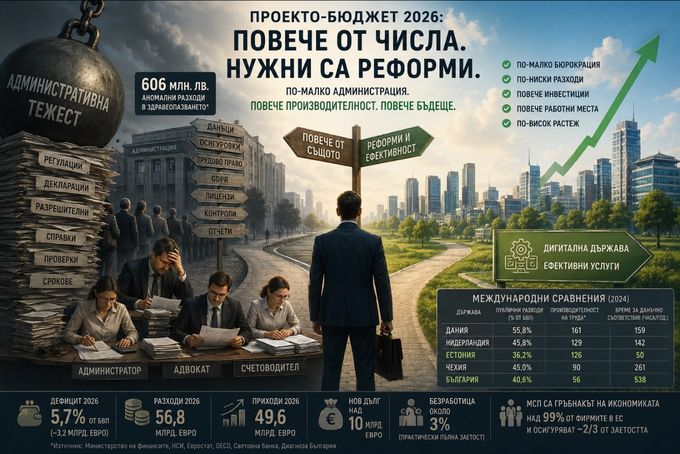
The draft provides for a deficit of 5.7% of GDP, revenues of about €49.6 billion, expenditures of about €56.8 billion, and the option to take on new government debt of over €10 billion. The government states that the goal is to gradually bring the deficit back below 3% by 2028. (bta.bg)
This is not the budget of a country in recession.
This is not the budget of a country in financial crisis.
This is the budget of an economy operating at nearly full employment.
Unemployment is already around 3%.
This means one very important thing.
The state can no longer increase employment.
It can only redistribute people between sectors.
Every new administrative position is almost inevitably filled by someone who would otherwise be working in the private sector.
In other words:
the state no longer merely regulates the labour market.
It competes with business for limited human capital.
And here comes the biggest paradox.
The private sector pays:
- income tax;
- corporate tax;
- VAT;
- social security contributions.
Then, with these funds, the state increases its own personnel spending.
After which it starts competing with that very same business for the same workers.
At nearly zero unemployment, this is an economically closed loop.
Not because civil servants are the problem.
But because the resource is already limited.
Here I want to make a very important distinction.
When I say "administration", I am not talking about:
- doctors;
- nurses;
- teachers;
- firefighters;
- police officers;
- judges;
- cybersecurity specialists;
- experts at the National Revenue Agency and the Customs Agency.
These people create public capital.
They are an investment.
Not an expense.
I am talking about the administrative activities that exist solely because overly complicated procedures exist.
The real deficit is not the fiscal one.
The real deficit is the deficit of reforms.
In the draft, I see more spending.
I see more revenue.
I see more debt.
But I see almost no programme for systematically increasing the productivity of the public sector.
The cheapest reform is the one that removes the need for the administration itself.
Digitalisation does not mean a PDF instead of paper.
It means:
the citizen not carrying certificates around at all.
Institutions exchanging information among themselves.
One register talking to another register.
The state ceasing to use its citizens as couriers between its own administrations.
There is one simple economic truth.
Every administrative procedure has a cost.
But it almost never appears in the budget.
It is paid by business.
By the accountant.
By the lawyer.
By the entrepreneur.
By the doctor.
By the engineer.
By all of us.
This cost is measured in millions of lost person-hours every year.
In recent weeks, the "Diagnosis Bulgaria" platform showed something extremely interesting.
Through analysis of public data, around BGN 606 million of anomalous spending was flagged in state and municipal healthcare. This does not automatically mean abuse, but it does mean that we now have tools that can systematically detect deviations and potential inefficiency, instead of relying only on inspections after a scandal. (bta.bg)
Imagine the same approach for every state institution.
Every contract.
Every expense.
Every staff position.
Every administrative process.
In real time.
The big question is:
Why is the first reaction to budget pressure almost always:
"We need more revenue."
And not:
"How do we produce more value with the same money?"
This is the difference between accounting thinking and economic thinking.
If I had to start a reform, I would start like this:
- ✔ A full functional audit of every administration.
- ✔ Measuring the public value of every administrative function.
- ✔ Automation before hiring.
- ✔ A freeze on administrative positions outside the critical systems.
- ✔ Retraining the freed-up human resource towards sectors with a chronic shortage of staff.
- ✔ Public performance indicators for every institution.
Not across-the-board layoffs.
Not populism.
But measurable productivity.
And one last thing.
There is a simple regularity in economics.
Wealth is not created by the budget.
The budget only redistributes wealth that has already been created.
The real producer of that wealth remains the private sector – the entrepreneurs, industry, services, exports, and the hundreds of thousands of micro, small, and medium-sized enterprises.
The state's job is not to replace them.
The state's job is to make sure they produce more.
And that does not happen with more administration.
It happens with less friction.
Less bureaucracy.
Fewer regulations without added value.
And with more productivity.
In my view, this is the reform missing from Draft Budget 2026.
There is one more cost of the budget that never enters the budget.
And that is the cost of lost entrepreneurship.
When we talk about the administrative burden, we usually think about government spending.
But the real cost is not paid by the state.
It is paid by business.
And above all by micro, small, and medium-sized enterprises.
Let us imagine an entrepreneur.
The reason for starting a company is simple.
To produce.
To sell.
To find clients.
To create new products.
To invest.
To bring value to the market.
Except that on the very first day, he realises that besides being an entrepreneur, he must become something else too.
He must become an expert in administrative law.
In labour legislation.
In tax law.
In accounting.
In social security.
In GDPR.
In occupational medicine.
In fire safety.
In health and safety at work.
In electronic signatures.
In registrations.
In declarations.
In reports.
In deadlines.
In inspections.
In licences.
In notifications.
In dozens more administrative regimes.
In practice, even before the business has started creating value, the entrepreneur is already building a team not for his business, but for the state.
From day one, he needs three additional "employees":
- ✔ an administrator;
- ✔ an accountant;
- ✔ a lawyer.
Not because the clients require them.
Not because the product requires them.
But because the administration requires them.
That is a fundamental difference.
And the smaller the business, the heavier this burden.
For an international corporation, such costs are a small part of the budget.
For a family firm with five employees, they can determine whether there will be any profit at all.
Every hour of bureaucracy is an hour in which no wealth is created.
In economics, there is the concept of opportunity cost.
The most expensive resource is not taxes.
The most expensive resource is the entrepreneur's time.
Every hour the entrepreneur spends filling in declarations, chasing certificates, tracking deadlines, or communicating with various administrations is an hour in which he:
- is not selling;
- is not developing a new product;
- is not finding a new client;
- is not training his people;
- is not investing.
This is not just an administrative expense.
This is forgone economic growth.
This is the hidden cost of the state.
It does not enter the budget.
But it enters the price of every good and every service.
Then comes the second blow.
Even if the entrepreneur decides to delegate all of this, another question arises.
To whom?
He decides: "Fine. I will hire people."
Except there is no one to hire.
With unemployment around 3%, Bulgaria has practically no available labour resource.
Because the state is also looking for people.
And here I am not talking about doctors, teachers, or firefighters.
I am talking about administrative positions that often exist solely because of the complexity of the administrative system itself.
A paradox emerges.
Business finances the state through taxes and social security contributions.
Then the state uses part of these revenues to become its competitor for the same people.
Every new administrative position means one more vacancy that the private sector has to bid for.
The result is predictable.
Labour costs rise.
But not because productivity is rising.
But because the shortage of people is growing.
This is one of the most dangerous forms of inflation.
And it increases the cost of every good and service.
This is perfectly visible in accounting services.
As a tax consultant, I see it every day.
A foreigner comes to Bulgaria, opens a company, and receives an offer for accounting services.
The first reaction is almost always:
"How can accounting cost that much?"
Many people think the reason is greed.
The truth is quite different.
The client compares the price with countries where the accountant mainly does accounting.
The Bulgarian accountant, however, rarely sells just bookkeeping.
In Bulgaria, the accountant is often:
- a tax consultant;
- a labour law specialist;
- a social security expert;
- an expert in administrative procedures;
- an intermediary between the business and the institutions;
- the person who monitors legislative changes daily and bears the compliance risk.
He sells time.
Time lost communicating with institutions.
Time lost keeping up with constantly changing legislation.
Time lost in administrative inspections.
Time lost preparing reports, declarations, notifications, statements, and correspondence.
Time that in a more efficient administrative system simply would not be necessary.
The client does not pay for debit and credit.
The client pays for the administrative complexity of the state.
This is the hidden tax on entrepreneurship.
It appears nowhere.
It does not enter the budget.
It does not enter the statistics.
But every entrepreneur pays it daily.
With time.
With nerves.
With missed opportunities.
With lower productivity.
With less innovation.
And ultimately – with lower economic growth.
In economics, there is the concept of transaction costs – costs that do not create a product, do not create a service, and do not bring added value, but exist solely because one has to interact with the system.
These are:
- filling in declarations;
- administrative registrations;
- licences;
- permits;
- inspections;
- correspondence;
- certificates;
- deadlines;
- reports;
- procedures.
Not one of these activities produces wealth.
They merely allow the business to continue existing.
In my view, this is the biggest missing reform.
Not yet another declaration.
Not yet another register.
Not yet another supervisory body.
But the opposite question:
How many administrative actions can we eliminate entirely?
Because the best administrative procedure is not the faster procedure.
The best administrative procedure is the one that no longer exists.
And precisely this, in my view, should be the criterion by which we evaluate every future reform.
The biggest tax in Bulgaria is not 10%.
It is not the corporate tax.
It is not the income tax.
It is not VAT.
The biggest tax is the cost of being an entrepreneur.
And it is almost never measured.
And here comes the comparison with countries like Estonia.
In Estonia, the philosophy is different.
The state accepts that if it already has a piece of information, it has no right to ask the citizen for it again.
Registers exchange data with each other.
Tax returns are often filed in minutes.
Most administrative services are performed entirely online.
Not because Estonians have fewer laws.
But because they have designed their administration to save businesses time instead of consuming it. (Wikipedia)
That is exactly why, in my view, the question is not:
"How much does the state spend?"
But:
"How much does interacting with the state cost society?"
Because a country can have high public spending and at the same time be an excellent environment for business.
Denmark.
The Netherlands.
Finland.
Sweden.
Estonia.
There, the cost of administration is not measured only in the budget.
It is measured in the time saved for business.
This, in my view, should be the next big reform in Bulgaria.
To start measuring not only what the administration costs the state.
But what the administration costs the entrepreneur!
This publication is for informational purposes only and does not constitute legal, tax, or investment advice.
This article is for information only and reflects the law as of its publication date. It is not individual tax or legal advice.

Author
Marina Muchakova
Tax consultant with a law degree and over 15 years of experience in tax law.